
If you’re someone who gets UTIs, you’ve probably been told to “drink cranberry juice” your whole life. Here’s the problem I run into as a pharmacist all the time: most cranberry juice and most cranberry pills barely have any of the part that actually matters. You’re getting a ton of sugar and almost none of the active ingredient.
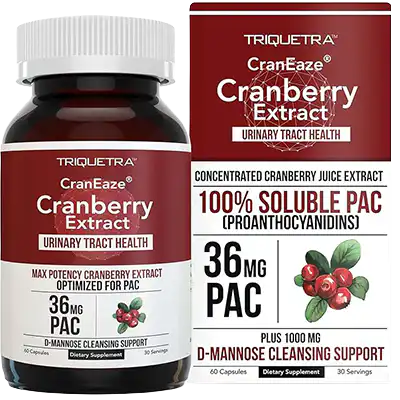
That’s the whole reason I like CranEaze by Triquetra — it’s built around the two ingredients with the actual science behind them, at doses that mean something.

What Actually Makes Cranberry Work
The magic in cranberry isn’t the juice — it’s a compound called PACs (proanthocyanidins). Here’s what PACs do: the bacteria that cause most UTIs (E. coli) have little hooks that grab onto the wall of your urinary tract so they can set up shop. PACs get in the way of those hooks, so the bacteria have a harder time sticking. Can’t stick, can’t cause trouble — they get flushed out instead.
The catch is dose. A lot of research points to around 36 mg of PACs as the amount that’s been studied for urinary tract support — and most grocery-store cranberry pills come nowhere close. CranEaze delivers a full 36 mg of PACs per serving, from cranberry juice extract, which is a more soluble, usable form than the ground-up whole-fruit powder a lot of cheap products use.
The Second Ingredient: D-Mannose
CranEaze doesn’t stop at cranberry. It also packs 1,000 mg of D-mannose, and this is the part I really like.
D-mannose is a simple sugar your body doesn’t really use for fuel — it mostly just passes through your urinary tract. On the way through, it works a lot like PACs but on a different type of bacterial hook: the E. coli latch onto the D-mannose instead of onto your bladder wall, and then get rinsed away when you pee. In the research, D-mannose has some of the more consistent results for urinary support, so having both it and the PACs in one capsule is a smart one-two punch.
The Honest Version
I always try to keep it straight with you. The cranberry research is genuinely mixed — some studies show a real drop in UTIs, others don’t, largely because so many products never used a real dose of PACs in the first place. That’s exactly why dose and form matter, and why I point people to a product that actually hits the studied 36 mg of PACs and adds D-mannose on top instead of hoping a splash of juice does the trick.
This is about support and prevention for people who deal with recurring urinary issues — not a treatment. If you think you have an active UTI, especially with fever, back pain, or blood, that’s a call-your-doctor situation. Cranberry supplements are for keeping things calm between episodes, not for putting out a fire.
How to Take It
It’s simple — capsules, two a day (that’s one serving, 36 mg PAC + 1,000 mg D-mannose). It’s marketed mostly toward women since that’s who deals with recurring UTIs most, but the biology works the same for anyone. No sugar bomb, no chugging juice.
Bottom line: if you’ve been leaning on cranberry juice or a cheap bottle of cranberry pills and wondering why it never seems to help, it’s almost certainly a dose-and-form problem. CranEaze is one of the few that’s built the way the research actually suggests — real PACs, real D-mannose, in amounts that mean something.
As always, I’m a pharmacist, not your pharmacist — check with your own provider before starting something new, especially if you’re pregnant, on blood thinners, or managing a health condition.
This post reflects my opinion as a pharmacist and is for educational purposes only. It is not medical advice, and these statements have not been evaluated by the FDA. This product is not intended to diagnose, treat, cure, or prevent any disease. I partner with Triquetra and may earn a commission from products I recommend.
Sources & Further Reading
- “The Clinical Trial Outcomes of Cranberry, D-Mannose and NSAIDs in the Prevention or Management of Uncomplicated Urinary Tract Infections in Women: A Systematic Review.” Pathogens (PMC). https://pmc.ncbi.nlm.nih.gov/
articles/PMC9788503/ - “Preventive effect of cranberries with high dose of proanthocyanidins on urinary tract infections: a meta-analysis and systematic review.” Frontiers in Nutrition. https://www.frontiersin.org/journals/nutrition/
articles/10.3389/fnut.2024.1422121/full - Cranberry — Uses, dosing, and warnings. WebMD. https://www.webmd.com/vitamins-supplements/cranberry
- Triquetra Health — CranEaze Urinary Tract Support (36 mg PAC + 1,000 mg D-mannose). https://triquetrahealth.com/products/craneaze-urinary-tract-support