
By now everyone’s heard of the GLP-1 drugs — Ozempic, Wegovy, Mounjaro. They work by mimicking a hormone your body already makes called GLP-1, which helps control hunger, cravings, blood sugar, and how full you feel after a meal.
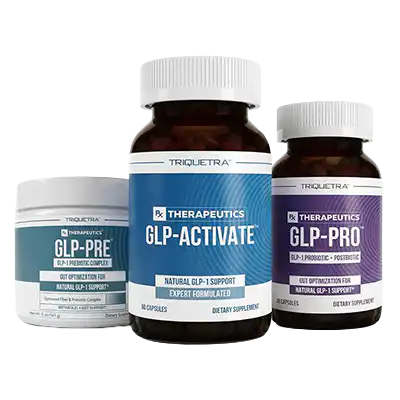
Here’s the part most people don’t realize: you make GLP-1 on your own, every time you eat. Some people just make and release it better than others. So the question I get all the time is, “Phil, is there a natural way to support my own GLP-1 instead of a shot?” That’s exactly what Triquetra’s GLP-Complete is built around — and it’s a 3-part system, not a single pill. Let me break down what each piece does.
First, Where GLP-1 Actually Comes From
GLP-1 is made by special cells in your gut called L-cells. When you eat, those cells sense it and release GLP-1, which tells your brain “we’re good, you’re full” and helps steady your blood sugar.
Two things heavily influence how well those L-cells work: the bacteria in your gut and the fuel those bacteria produce (short-chain fatty acids like butyrate). A healthier, better-fed gut tends to mean better GLP-1 signaling. That’s the whole logic behind GLP-Complete — feed the gut, support the bacteria, and support the mealtime response. Three products, three jobs.
GLP-Pre — Feed the Good Bacteria
GLP-Pre is the prebiotic step. It’s a scoop of targeted fiber — resistant starch, PreticX® XOS, and mushroom beta-glucans — that you mix into water, coffee, or a smoothie once a day.
Think of this as fertilizer. The fibers here are the specific kind your beneficial gut bacteria love to eat, and when they eat them they pump out those short-chain fatty acids that fuel your GLP-1-making L-cells. You can’t grow a good garden without feeding the soil first — this is the soil.
GLP-Pro — Plant and Support the Bacteria
GLP-Pro is the probiotic + postbiotic step, taken as one capsule with your first meal.
This is where it gets clever. It includes Akkermansia muciniphila, a gut bacterium that’s become a huge deal in metabolic research — it’s been tied to better insulin sensitivity and directly to nourishing those L-cells. It also has ButyraGen, a butyrate precursor (butyrate is the preferred fuel for L-cells), plus a trio of spore-based probiotics that survive stomach acid and get to work in the colon producing more of those beneficial fatty acids. If GLP-Pre is the fertilizer, GLP-Pro is planting the right seeds and protecting the gut lining while they grow.
GLP-Activate — Support the Mealtime Response
GLP-Activate is the one you take around meals — one capsule about 30 to 60 minutes before eating, up to three times a day.
This is the botanical piece, built on ingredients with a long history in metabolic support: berberine (which has real research behind it for blood sugar and metabolism), green tea extract, Ceylon cinnamon, curcumin, taurine, and phenylcapsaicin. The idea here is different from the other two — instead of building up your gut over time, this one supports appetite control and post-meal metabolic balance in the moment, when you’re actually sitting down to eat.
The Honest Version
I’ll always keep it straight with you. This is not Ozempic in a capsule, and it’s not a replacement for a prescribed GLP-1 drug. Triquetra says so themselves — there’s no synthetic GLP-1 in here. What this system does is support your body’s own GLP-1 pathways through your gut, and that’s a slow build, not an overnight switch. They suggest giving it 3 to 6 months of consistent use, and like anything in this space it works alongside decent food and movement, not instead of them.
So who’s it actually for? People who want to support their metabolism and appetite naturally, people who aren’t on (or don’t want) the injectables, or people looking to support gut health and GLP-1 signaling the long way. The reason it comes as three products is that no single pill can feed the gut, seed the gut, and support mealtime all at once — those are genuinely three different jobs.
As always, I’m a pharmacist, not your pharmacist — check with your own provider before starting something new, especially if you’re on medication (berberine in particular can interact with things like blood sugar meds), pregnant, or managing a health condition.
This post reflects my opinion as a pharmacist and is for educational purposes only. It is not medical advice, and these statements have not been evaluated by the FDA. This product is not intended to diagnose, treat, cure, or prevent any disease, and is not a substitute for GLP-1 agonist medications. I partner with Triquetra and may earn a commission from products I recommend.
Sources & Further Reading
- “Effect of Akkermansia muciniphila on GLP-1 and Insulin Secretion.” Nutrients (MDPI). https://www.mdpi.com/2072-6643/17/15/2516
- “The mechanism of berberine alleviating metabolic disorder based on gut microbiome.” Frontiers in Cellular and Infection Microbiology. https://www.frontiersin.org/journals/cellular-and-infection-microbiology/articles/10.3389/fcimb.2022.854885/full
- “Review of Literature on Akkermansia muciniphila and its Possible Role in Type 2 Diabetes Mellitus.” PMC. https://pmc.ncbi.nlm.nih.gov/articles/PMC9242659/
- Triquetra Health — GLP-Complete 3-Step System. https://triquetrahealth.com/products/glp-complete
- Triquetra Health — GLP-Activate. https://triquetrahealth.com/products/glp-activate
- Triquetra Health — GLP-Pro (Probiotic & Postbiotic). https://triquetrahealth.com/products/glp-pro-glp-1-probiotic-postbiotic