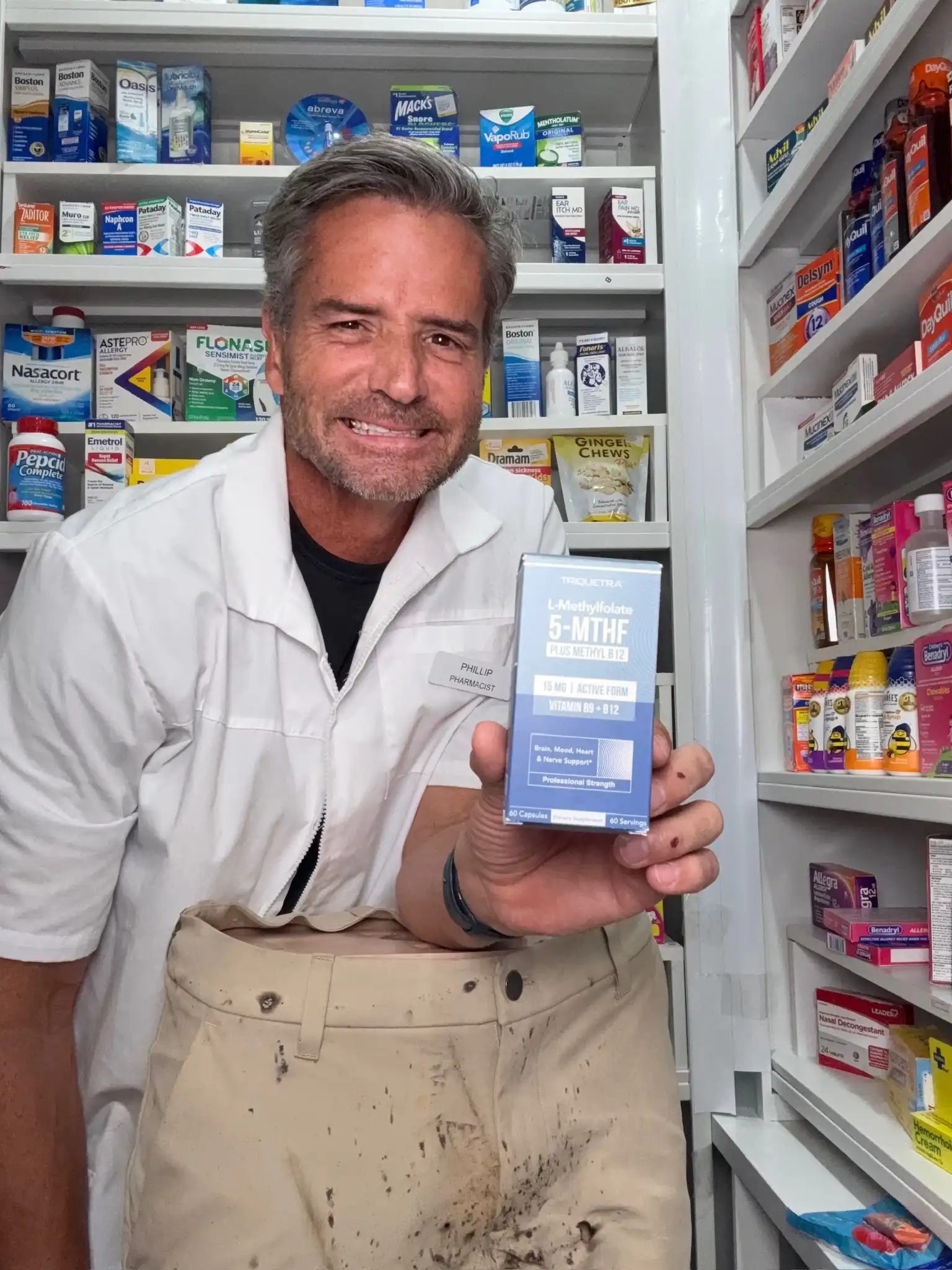
Here’s something that blew my mind as a pharmacist. Almost half the population has a gene mutation called MTHFR, and most have no idea. If you’ve got it, your body can’t properly convert the folic acid in your multivitamin into the form it actually needs. So that “complete” multivitamin? A big chunk of the folate is literally getting peed out. You’re paying for a nutrient your body can’t use.
That’s where L-Methylfolate comes in — one of the supplements I recommend most.
What It Is
Folate is vitamin B9 — your body needs it for brain development, mood, DNA repair, and methylation (the process that keeps your cells running clean). But most vitamins use folic acid, the cheap synthetic form. Folic acid isn’t usable on its own; your body has to convert it, and the MTHFR enzyme is what does that job. If you have the mutation, that enzyme runs slow — so the folic acid piles up unconverted and the active folate your brain is begging for never shows up.
L-Methylfolate (or 5-MTHF) skips the whole problem. It’s already in the finished, body-ready form. No conversion required. Think of it like a key and a lock: folic acid is the wrong-shaped key that rattles but never opens the door. L-Methylfolate is cut to fit. Click, you’re in.
Why It’s Not Just Hype
Unlike folic acid, L-Methylfolate crosses the blood-brain barrier — meaning it actually gets into your brain, where it helps produce the building blocks for serotonin, dopamine, and norepinephrine. In studies using it as an add-on for people already on an antidepressant, the 15 mg dose beat placebo, while the lower 7.5 mg dose didn’t. That’s a big reason I usually point people to the 15 mg strength when mood is the goal — and why I say it can benefit everyone, not just people with the mutation.
Drops, Pills, or the Kids Version
I like Triquetra’s line here because they pair the 5-MTHF with methyl B12, it’s third-party tested, and it comes in every format you’d need.
The Pills (Capsules). The no-fuss option — one a day, done. Comes in 15 mg (my go-to for adults), 7.5 mg, and 1 mg for gentler daily support. Best if you like a simple pill and don’t mind swallowing capsules.
The Drops (Liquid Dropper). Same active ingredients, more flexibility. Same 15 / 7.5 / 1 mg strengths, but you can dial the dose up or down, and take it under the tongue or in water, juice, or a smoothie. My favorite if you hate swallowing pills.
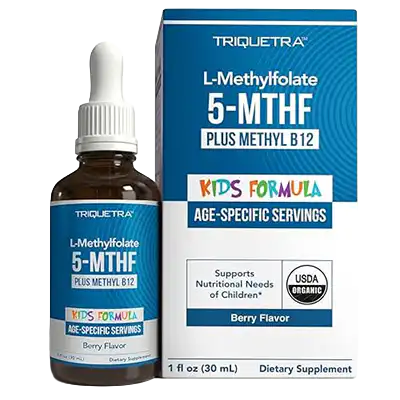
The Kids Version. Kids can have the MTHFR mutation too, and folate matters enormously for a developing brain — but you’re not getting a toddler to swallow a 15 mg capsule. Triquetra’s Kids L-Methylfolate is a liquid dropper made for exactly this: adjustable dosing by age (roughly 10 drops for ages 1–3, 20 for 4–13, 30 for teens), berry or unflavored, and clean — no synthetic folic acid, sugar, or dyes. Give it straight, in a drink, or mixed into applesauce. One caution: if your child has a seizure disorder, check with your doctor first.
So Which Do You Need?
Like pills and want simple? The 15 mg capsules. Hate pills or want dosing flexibility? The drops. Focused on mood? Lean 15 mg — that’s the dose with research behind it. Just want general methylation support? 1 mg or 7.5 mg is plenty. Kids? The liquid dropper, dosed by age.
Bottom line: if you’ve been faithfully taking a multivitamin and still feel off — low mood, brain fog, low energy — there’s a real chance your body isn’t converting folic acid the way it should. Switching to L-Methylfolate is one of the simplest, most evidence-backed changes you can make.
As always, I’m a pharmacist, not your pharmacist — check with your own provider before starting something new, especially if you’re pregnant, on medication, or managing a health condition.
This post reflects my opinion as a pharmacist and is for educational purposes only. It is not medical advice, and these statements have not been evaluated by the FDA. This product is not intended to diagnose, treat, cure, or prevent any disease. I partner with Triquetra and may earn a commission from products I recommend.
Sources & Further Reading
- “A Review of L-Methylfolate as Adjunctive Therapy in the Treatment of Major Depressive Disorder.” The Primary Care Companion for CNS Disorders. https://www.psychiatrist.com/pcc/a-review-of-l-methylfolate-as-adjunctive-therapy-in-the-treatment-of-major-depressive-disorder/
- Fava M, Mischoulon D. “The Evolving Story of Folate in Depression and the Therapeutic Potential of L-Methylfolate.” American Journal of Psychiatry. https://psychiatryonline.org/doi/10.1176/appi.ajp.2012.12091207
- Triquetra Health — L-Methylfolate Collection & Kids L-Methylfolate. https://triquetrahealth.com/collections/l-methylfolate | https://triquetrahealth.com/pages/l-methylfolate-kids
- Phil’s My Pharmacist — “MTHFR: How Nutrition Affects Depression.” https://philsmypharmacist.com/how-nutrition-effects-depression/